Short-Run Metal Fabrication
Overview
Preserved shop record for hilliardprecision.com. The former plant is not quoting from this domain. Hilliard Precision Products, LLC carries a long memory in its name. E.C. Hilliard Company was founded in 1903. In 2006 the company was purchased by Sanweld Industries, a holding company with several business units in the metal working industry, and renamed Hilliard Precision Products, LLC. The preserved pages describe a shop that provides high quality custom crafted precision metal fabrication for a growing, continually diversifying marketplace. The mission language is plain: integrity, uncompromising, and a reputation for achieving the most demanding fabrications. The shop record also notes ISO 9001:2000 registration, with quality manuals available upon request. Future growth is tied to continuing investments in advanced equipment and technology, coupled with a skilled dedicated staff. F
Details
or short run metal fabrication, the process language begins with the facility itself. The manufacturing facility comprises 50,000 square feet for manufacturing and finishing and 8,000 square feet for offices, engineering and design. The warehouse includes rack storage capabilities, five loading docks and a five-ton crane. That layout matters for short runs because material handling, staging, and finishing are not afterthoughts. A short run still moves through receiving, storage, cutting, forming, welding, deburring, inspection, and shipment. The shop capabilities and facilities list are part of the same record, and the engineering and design function sits alongside the shop floor rather than apart from it. The equipment list preserved on the site includes a Trumpf B 200 Press Brake and V855 Press Brake, HE&M Saw, Global Shop ERP Software, Robotic Welder, and Automated Large Capacity Laser Cutting. The news pages also announce the installation of a Bystronic 3500 Watt Laser metal cutting machine. For short run work, these are the tools that set the rhythm. A press brake forms the bends. A saw cuts stock to length. A laser cuts flat profiles and nested parts. A robotic welder handles repeatable weldments. The ERP software tracks the order through the shop. None of this is quoted from the domain now; it is simply the preserved process language of the plant. The sales conditions preserved on the site give the clearest picture of how short runs are handled. Quotations are valid for 7 days after date of quotation, and stenographic and clerical errors are subject to correction. Quantities: buyer will accept overruns or underruns not to exceed 10% of quantity ordered, except that on orders of under 10 pieces the overrun may be up to 2 pieces unless otherwise specified. That clause is written for short runs. A ten-piece order is not a mass production order. The shop allows for the practical reality of setup, cut length, and piece count. Burrs are addressed directly. All parts will be deburred by sanding one side unless otherwise specified. Sharp corners will be broken only if specified on the prints. For short run metal fabrication, deburring is often where the hand work lives. A short run may not justify a dedicated deburring fixture, so the specification on the print controls the operation. If the print does not call out broken corners, the shop does not assume them. If the customer wants a specific edge condition, it belongs on the print. Engineered charges and tooling charges are described as one-time non-recurring charges. The engineering charge covers the cost of engineering and CNC tapes. No further charge is made except for part design changes made by the buyer. The tooling charge covers the cost of purchase or adapting and fabricating special tools, dies and fixtures. These are adaptable only to the shop's machines and will not be released from the plant. The shop assumes responsibility for replacing worn out or damaged tools, dies and fixtures. In short run work, this is the boundary between the customer's design and the shop's process. The tooling stays with the machines. The engineering tape stays with the job. If the buyer changes the design, the charge structure follows. Quality language is present in the preserved conditions. All manufacturing processes are carried out to the customer's specifications. Tolerances are stated in the record: inch for the first two inches; .003 per inch thereafter unless otherwise stated. Claims must be submitted for quality, quantity discrepancies or finish quality within 30 days. Credit will not be issued until parts are returned. Buyer must call for Return Material Authorization number prior to shipment. Materials: analysis reports and certification of compliance on material will be furnished if requested by customer at the time of order. For short runs, material certification is often requested at the time of order because the heat lot and mill report need to be tied to the job. The shop record does not invent certifications; it states that reports are furnished if requested at the time of order. The conditions also address finish. Scratches, pits, marks, or waterproofing and rust prevention may involve additional charges where special handling and treatment are requested. In short run fabrication, finish is frequently the last variable. A part may be cut, formed, and welded correctly, but the surface condition and protection determine whether it meets the customer's expectation. The shop record treats that as a specified item, not an assumed one. Terms are accepted at Hilliard Precision Products in Franklin, Mass. Open account to those having satisfactory credit rating or those who furnish satisfactory references; to all others, terms to be agreed upon at time of order. Placement of order either verbal or written shall signify acceptance of Hilliard Precision Products standard terms. F.O.B. Factory, Franklin, Mass. Terms net 30 days. Cancellation language is also preserved: charges will be made for costs including engineering, overhead, raw material, work in process, tools, dies, fixtures, storage, transportation and interest. For short run metal fabrication, cancellation cost is not a penalty; it is the record of what has already been committed to the job. The shop's heritage also includes architectural and ornamental metalwork, Allcraft Marine, Water Heaters, and Van Noorden Gate Systems. Those product lines sit alongside the custom fabrication work. The news pages mention that the company was looking for manufacturer's reps to represent its sheet metal line to customers in the northeast, with compatible lines and prior or current sheet metal line a plus. That is part of the preserved record, and it shows the shop's orientation toward sheet metal fabrication as a continuing line. What remains for short run metal fabrication is the same sequence the preserved pages describe: engineering and design, laser cutting, saw cutting, press brake forming, robotic welding, deburring, inspection, and finishing. The shop's process language is not a promise of any particular lead time or price. It is a record of how the plant described its own capabilities and conditions. The former plant is not quoting from this domain. The preserved pages simply show a shop that was built for custom crafted precision metal fabrication, including the short runs where setup, tooling, material certification, deburring, and finish specification all matter.
Drill size reference
| Drill | Decimal inch | Millimetres |
|---|---|---|
| #1 | 0.2280 | 5.791 |
| #7 | 0.2010 | 5.105 |
| #13 | 0.1850 | 4.699 |
| #21 | 0.1590 | 4.039 |
| #29 | 0.1360 | 3.454 |
| #36 | 0.1065 | 2.705 |
| #43 | 0.0890 | 2.261 |
| #53 | 0.0595 | 1.511 |
| 1/16 | 0.0625 | 1.587 |
| 5/64 | 0.0781 | 1.984 |
| 3/32 | 0.0938 | 2.381 |
| 7/64 | 0.1094 | 2.778 |
| 1/8 | 0.1250 | 3.175 |
| 9/64 | 0.1406 | 3.572 |
| 5/32 | 0.1562 | 3.969 |
| 11/64 | 0.1719 | 4.366 |
| 3/16 | 0.1875 | 4.763 |
| 13/64 | 0.2031 | 5.159 |
| 7/32 | 0.2188 | 5.556 |
| 15/64 | 0.2344 | 5.953 |
| 1/4 | 0.2500 | 6.350 |
| 5/16 | 0.3125 | 7.938 |
| 3/8 | 0.3750 | 9.525 |
| 7/16 | 0.4375 | 11.113 |
| 1/2 | 0.5000 | 12.700 |
| F | 0.2570 | 6.528 |
| H | 0.2660 | 6.756 |
| L | 0.2900 | 7.366 |
| P | 0.3230 | 8.204 |
| S | 0.3480 | 8.839 |
| W | 0.3860 | 9.804 |
| Z | 0.4130 | 10.490 |
Common questions
What is a #1 drill bit in inches and millimetres?
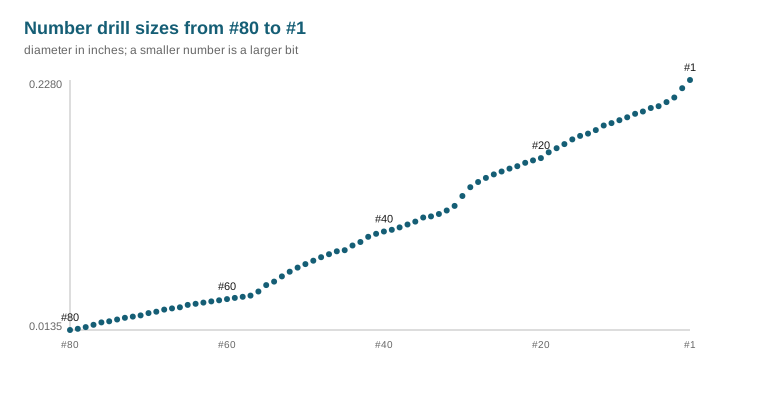
A #1 drill bit is 0.2280 in, which is 5.791 mm. Number drills run from #80 at 0.0135 in up to #1 at 0.2280 in, so a smaller number is always a larger bit.
What is a #7 drill bit in inches and millimetres?
A #7 drill bit is 0.2010 in, which is 5.105 mm. Number drills run from #80 at 0.0135 in up to #1 at 0.2280 in, so a smaller number is always a larger bit.
What is a #13 drill bit in inches and millimetres?
A #13 drill bit is 0.1850 in, which is 4.699 mm. Number drills run from #80 at 0.0135 in up to #1 at 0.2280 in, so a smaller number is always a larger bit.
This page is an archival note for informational purposes only. It does not offer representation, evaluate claims, or create a professional relationship.