Stainless Steel Fabrication
Overview
Preserved Shop Record: Hilliard Precision Products, LLC The preserved pages for hilliardprecision.com describe a metal fabrication shop with a long operating history. E.C. Hilliard Company was founded in 1903. In 2006 the company was purchased by Sanweld Industries, a holding company with several business units in the metal working industry, and renamed Hilliard Precision Products, LLC. The shop describes itself as providing high quality custom crafted precision metal fabrication for a growing, continually diversifying marketplace. Its stated mission language centers on integrity, demanding fabrications, and continuing investment in equipment and skilled staff. The facility record lists 50,000 square feet for manufacturing and finishing and 8,000 square feet for offices, engineering, and design. The warehouse includes rack storage, five loading docks, and a five-ton crane. The shop cap
Details
abilities and equipment notes include Trumpf B 200 Press Brake and V855 Press Brake, HE&M Saw, Global Shop ERP Software, Robotic Welder, and Automated Large Capacity Laser Cutting. A Bystronic 3500 Watt Laser metal cutting machine is also noted in the news pages. The preserved pages mention ISO 9001:2000 registration and state that quality manuals are available upon request. The shop also lists architectural and ornamental metalwork, Allcraft Marine, Water Heaters, Van Noorden, and Van Noorden Gate Systems among its pages. For stainless steel fabrication, the process language preserved from this shop points to a job-shop model built around engineering, laser cutting, forming, welding, deburring, inspection, and documentation. Stainless steel is not described as a separate department in the preserved pages, but the shop's general fabrication language applies directly to stainless work when the material is specified on the print and order. The process begins with engineering and design. The preserved pages list Engineering & Design as a capability and refer to engineering charges as one-time non-recurring charges covering the cost of engineering and CNC tapes. For stainless steel fabrication, that means the shop reviews the part geometry, material specification, thickness, finish requirements, and any special handling notes before releasing to the floor. The engineering charge is not repeated unless the buyer changes the part design. Tooling charges are also one-time non-recurring and cover the cost of purchasing or adapting and fabricating special tools, dies, and fixtures. Those tools are adaptable only to the shop's machines and are not released from the plant. The shop assumes responsibility for replacing worn out or damaged tools, dies, and fixtures. Laser cutting is a central step. The preserved pages announce automated large capacity laser cutting and a Bystronic 3500 Watt Laser metal cutting machine. For stainless steel, laser cutting establishes the blank profile, cutouts, and hole patterns. The shop's Laser FAQs page is referenced in the preserved record, indicating that laser cutting is a defined process area rather than an incidental operation. After cutting, forming follows on press brakes. The Trumpf B 200 Press Brake and V855 Press Brake are listed as new equipment. Stainless steel forming requires attention to springback, tooling condition, and surface protection. The preserved pages do not list specific stainless grades or thickness ranges, so the shop's process language remains general: the print and order define the material and tolerances. Welding is listed through the Robotic Welder. For stainless steel fabrication, welding may be manual or robotic depending on the joint and quantity. The preserved pages do not describe weld procedures, filler metals, or post-weld cleaning in detail. What they do show is a shop that organizes work through engineering, CNC tapes, tooling, and inspection. The quality section states that all manufacturing processes are inspected to the print. The preserved tolerance language notes .005 inch for the first two inches and .003 per inch thereafter unless otherwise stated. That language is general to the shop's fabrication work and would apply to stainless steel parts when the print does not call out otherwise. Deburring is addressed in the sales conditions. All parts will be deburred by sanding one side unless otherwise specified. Sharp corners will be broken only if specified on the prints. For stainless steel, that means edge condition and corner treatment follow the print. If a customer needs both sides deburred, specific corner breaks, or a particular surface finish, that must be specified. The preserved pages also note that special handling and treatment for scratches, pits, marks, or for waterproofing and rust prevention may involve additional charges where requested. Stainless steel is often selected for corrosion resistance, but the shop's language still treats surface protection and special handling as order-specific requirements. Material documentation is covered in the sales conditions. Analysis reports and certification of compliance on material will be furnished if requested by the customer at the time of order. The preserved pages do not list specific stainless steel grades, mill sources, or certification types beyond that general statement. The shop also states that quality manuals are available upon request and that it is an ISO 9001:2000 company. No other certifications are named in the preserved record. Order handling and claims are also part of the process language. Quotations are valid for 7 days after date of quotation. Stenographic and clerical errors are subject to correction. Buyer will accept overruns or underruns not to exceed 10% of quantity ordered, except that on orders of under 10 pieces the overrun may be up to 2 pieces unless otherwise agreed. Claims for quality, quantity discrepancies, or finish quality must be submitted within 30 days. Credit will not be issued until parts are returned, and the buyer must call for a Return Material Authorization number prior to shipment. Orders are accepted at Hilliard Precision Products in Franklin, Massachusetts. Open account terms are available to those having satisfactory credit rating or those who furnish satisfactory references; to all others, terms are agreed upon at time of order. Placement of order, verbal or written, signifies acceptance of the shop's standard terms. F.O.B. Factory, Franklin, Massachusetts. Terms are net 30 days. The preserved pages also mention manufacturer's representatives for the sheet metal line in the northeast, with compatible lines and prior or current sheet metal line experience as a plus. That detail shows the shop's sales model includes representation beyond direct inquiries. The news pages list new equipment and ERP software, indicating continuing investment in capacity and shop management. For stainless steel fabrication, the preserved record supports a process sequence of engineering review, laser cutting, press brake forming, robotic or manual welding, deburring by sanding one side unless otherwise specified, inspection to the print, and material documentation if requested at the time of order. The shop's language does not promise specific stainless finishes, weld colors, passivation, or certification beyond what is stated. Any stainless-specific requirement must be written on the print or order and confirmed through the shop's standard conditions. The preserved pages describe a shop that has been operating since 1903, was purchased by Sanweld Industries in 2006, and continues to describe itself as a precision metal fabrication source with a diversifying marketplace. That is the process language available from this record.
Drill size reference
| Drill | Decimal inch | Millimetres |
|---|---|---|
| #1 | 0.2280 | 5.791 |
| #7 | 0.2010 | 5.105 |
| #13 | 0.1850 | 4.699 |
| #21 | 0.1590 | 4.039 |
| #29 | 0.1360 | 3.454 |
| #36 | 0.1065 | 2.705 |
| #43 | 0.0890 | 2.261 |
| #53 | 0.0595 | 1.511 |
| 1/16 | 0.0625 | 1.587 |
| 5/64 | 0.0781 | 1.984 |
| 3/32 | 0.0938 | 2.381 |
| 7/64 | 0.1094 | 2.778 |
| 1/8 | 0.1250 | 3.175 |
| 9/64 | 0.1406 | 3.572 |
| 5/32 | 0.1562 | 3.969 |
| 11/64 | 0.1719 | 4.366 |
| 3/16 | 0.1875 | 4.763 |
| 13/64 | 0.2031 | 5.159 |
| 7/32 | 0.2188 | 5.556 |
| 15/64 | 0.2344 | 5.953 |
| 1/4 | 0.2500 | 6.350 |
| 5/16 | 0.3125 | 7.938 |
| 3/8 | 0.3750 | 9.525 |
| 7/16 | 0.4375 | 11.113 |
| 1/2 | 0.5000 | 12.700 |
| F | 0.2570 | 6.528 |
| H | 0.2660 | 6.756 |
| L | 0.2900 | 7.366 |
| P | 0.3230 | 8.204 |
| S | 0.3480 | 8.839 |
| W | 0.3860 | 9.804 |
| Z | 0.4130 | 10.490 |
Common questions
What is a #1 drill bit in inches and millimetres?
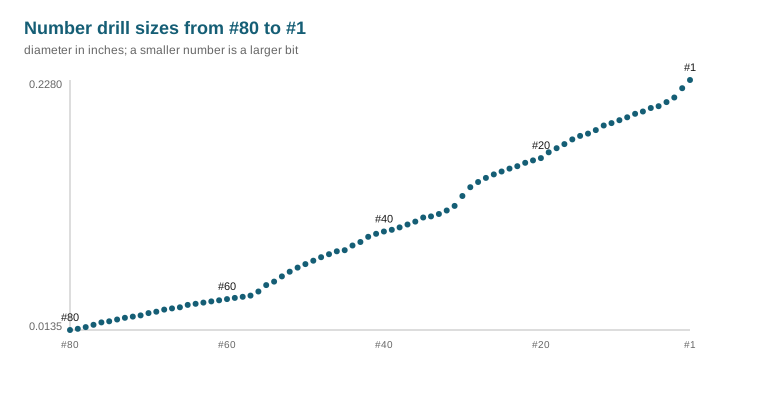
A #1 drill bit is 0.2280 in, which is 5.791 mm. Number drills run from #80 at 0.0135 in up to #1 at 0.2280 in, so a smaller number is always a larger bit.
What is a #7 drill bit in inches and millimetres?
A #7 drill bit is 0.2010 in, which is 5.105 mm. Number drills run from #80 at 0.0135 in up to #1 at 0.2280 in, so a smaller number is always a larger bit.
What is a #13 drill bit in inches and millimetres?
A #13 drill bit is 0.1850 in, which is 4.699 mm. Number drills run from #80 at 0.0135 in up to #1 at 0.2280 in, so a smaller number is always a larger bit.
This page is an archival note for informational purposes only. It does not offer representation, evaluate claims, or create a professional relationship.